
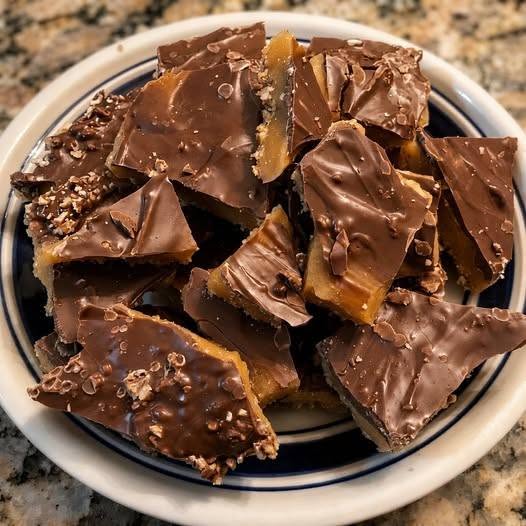

This diabetic-friendly English Toffee is buttery, crisp, nutty, and wonderfully rich, giving you that classic homemade toffee experience with less added sugar. A golden, crunchy toffee layer is topped with smooth sugar-free chocolate and toasted nuts for a satisfying treat that’s perfect for gifting, holidays, or enjoying in small portions.
Can This English Toffee Support Weight Loss Goals?
It can fit into a balanced, portion-conscious eating pattern when enjoyed occasionally. Using a sugar alternative can reduce added sugar, but butter, chocolate, and nuts still make toffee calorie-dense. Keeping portions small is the best way to enjoy it while maintaining overall balance.
Does This English Toffee Fit a High-Protein Lifestyle?
English toffee isn’t naturally a high-protein dessert, although nuts contribute a small amount of protein. Choosing almonds or peanuts can slightly increase the protein content. For a higher-protein eating pattern, enjoy a small piece alongside a protein-rich snack rather than treating the toffee itself as a protein source.
Why This Recipe is Special:
- Reduced-sugar approach — Uses a suitable sugar alternative instead of traditional white sugar.
- Buttery and crunchy — Delivers the classic crisp English toffee texture.
- Chocolate-covered — A thin layer of sugar-free chocolate adds extra richness.
- Nutty and satisfying — Toasted almonds provide crunch and flavor.
- Perfectly portionable — Break into small pieces for controlled servings.
My Personal Experience
- The buttery aroma is the first thing I notice.
As the toffee cooks, the kitchen fills with that unmistakable caramel-like scent. - I love the contrast between crunchy toffee and chocolate.
The smooth chocolate layer softens the intense crunch just enough. - Toasted almonds make every bite better.
Their nutty flavor balances the richness of the butter and chocolate. - Small pieces are surprisingly satisfying.
Because the flavor is so rich, you don’t need a large portion to enjoy it.
Perfect For:
This toffee is ideal for holiday dessert trays, Christmas gifts, parties, afternoon treats, homemade food gifts, dessert boards, and portion-controlled sweet snacks.
Why You’ll Love This Recipe:
- Classic homemade flavor
Rich butter, toasted nuts, and chocolate create that familiar English toffee taste. - Crunchy texture
Properly cooked toffee sets firm and snaps beautifully. - Lower in added sugar
A sugar alternative helps reduce the traditional sugar load. - Easy to portion
Break the finished slab into small bite-sized pieces. - Great for gifting
Package individual pieces in parchment or a decorative container.
Common Mistakes to Avoid:
- Not using a candy thermometer — Accurate temperature is important for achieving the correct hard-crack texture.
- Cooking too quickly — Excessively high heat can cause the butter to separate or burn.
- Stirring incorrectly — Constant gentle stirring helps prevent scorching and uneven cooking.
- Adding chocolate too early — Let the toffee cool briefly before adding chocolate so it melts without becoming excessively oily.
Required Equipment:
- Heavy-bottomed saucepan — Distributes heat evenly and reduces scorching.
- Candy thermometer — Helps achieve the correct toffee temperature.
- Baking sheet — Provides a flat surface for setting the toffee.
- Parchment paper — Prevents sticking and makes removal easy.
- Heat-resistant spatula — Makes stirring the thick toffee mixture easier.
Storage Instructions:
Once completely cooled and hardened, break the toffee into small pieces and store in an airtight container.
Keep at cool room temperature for up to 1 week, or refrigerate for up to 2 weeks.
For longer storage, freeze in an airtight freezer-safe container for up to 2 months. Separate layers with parchment paper to prevent sticking.
Recipe Details
Preparation Time: 10 minutes
Cooking Time: 15–20 minutes
Total Time: 30 minutes
Servings: 24 small pieces
Best Season: All-season, especially fall and winter
Total Calories: Approximately 125 calories per piece
Short Description
Buttery, crunchy English toffee is topped with sugar-free chocolate and toasted almonds.
This reduced-sugar version delivers classic homemade toffee flavor in small portions.
Perfect for holiday trays, gifting, or an occasional sweet treat.
📝 Ingredients
- 1 cup unsalted butter
- ¾ cup allulose or a suitable granulated sugar substitute designed for candy-making
- 2 tablespoons water
- 1 teaspoon vanilla extract
- ¼ teaspoon salt
- 1 cup toasted almonds, finely chopped
- 5 oz sugar-free dark chocolate, chopped
- 1 teaspoon coconut oil — optional, for smoother chocolate
- Pinch of flaky sea salt — optional
Important Note: Not every sugar substitute behaves like sugar when heated. Allulose is not ideal for traditional hard-crack toffee because it browns and sets differently from sucrose. For the most reliable diabetic-friendly version, use a commercially available sugar substitute specifically formulated for hard candy/toffee and follow its package instructions.
Directions
- Prepare the pan:
Line a baking sheet with parchment paper. Sprinkle half of the chopped almonds evenly over the surface. - Start the toffee:
Add butter, your chosen candy-making sweetener, water, and salt to a heavy-bottomed saucepan. - Heat gently:
Cook over medium-low heat, stirring continuously with a heat-resistant spatula until the butter melts and the mixture becomes smooth. - Cook the mixture:
Continue cooking over medium heat, stirring steadily. Monitor the temperature closely with a candy thermometer. - Watch the color:
Continue cooking until the mixture reaches the temperature specified by your chosen candy sweetener’s instructions and develops a deep golden-brown appearance. Don’t rely on color alone because sugar alternatives behave differently. - Add vanilla:
Remove from the heat and carefully stir in vanilla extract. Be cautious because the mixture may bubble vigorously. - Pour the toffee:
Immediately pour the hot mixture over the chopped almonds on the prepared baking sheet. Spread gently into an even layer. - Add chocolate:
Let the toffee cool for approximately 3–5 minutes, then scatter chopped sugar-free chocolate over the surface. - Spread the chocolate:
Allow the chocolate to soften for 2–3 minutes, then spread it evenly with a spatula. - Add remaining almonds:
Sprinkle the remaining chopped almonds over the melted chocolate. Add a small pinch of flaky sea salt if desired. - Cool completely:
Leave the toffee at room temperature for 1–2 hours, or refrigerate for about 30–45 minutes, until completely firm. - Break into pieces:
Remove the hardened toffee from the parchment and break it into approximately 24 small pieces.
Diabetic-Friendly Cooking Tip
The sweetener is the most important ingredient to choose carefully. Look for a candy-making sugar substitute with clearly stated carbohydrate and sugar information, because some sugar alcohols and alternative sweeteners behave differently when heated. Always account for the carbohydrates from the chocolate, nuts, and any sweetener used.
Nutrition Facts — Per Piece, Approximate
- Calories: 125 kcal
- Fat: 11 g
- Cholesterol: 20 mg
- Sodium: 55 mg
- Potassium: 55 mg
- Total Carbohydrates: 5 g
- Fiber: 1.5 g
- Net Carbs: 3.5 g
- Sugars: 1 g
- Protein: 2 g
- Calcium: 25 mg
Nutrition values are approximate and depend heavily on the sweetener and sugar-free chocolate used.
Notes
- Use a candy thermometer for the most consistent results.
- Candy-making sweeteners can behave very differently from regular sugar.
- Let the toffee cool completely before breaking it apart.
- Store away from heat and moisture to preserve the crunch.
- Use sugar-free chocolate with minimal added sugar.
- Almonds can be replaced with pecans, walnuts, or hazelnuts.
- Allergy note: This recipe contains dairy, almonds, and potentially soy depending on the chocolate. Use suitable alternatives if needed.
- For diabetes management, check the nutrition label of your specific ingredients and keep portions modest.
Frequently Asked Questions
1. Can I make English toffee without regular sugar?
Yes, but use a sugar substitute specifically designed for candy-making because ordinary sugar alternatives may not caramelize or set correctly.
2. Why did my toffee become soft?
The mixture may not have reached the correct candy stage, or moisture may have been absorbed during storage.
3. Can I use dark chocolate instead of milk chocolate?
Yes, sugar-free dark chocolate works especially well because its slight bitterness balances the rich toffee.
4. Can I use different nuts?
Absolutely; pecans, walnuts, hazelnuts, and peanuts can all work well.
5. Can I freeze the toffee?
Yes, store it in an airtight freezer-safe container for up to 2 months.
6. Is this toffee suitable for people with diabetes?
It is designed as a reduced-sugar option, but it is still calorie-dense and contains carbohydrates, so portion size and the specific ingredients used matter.