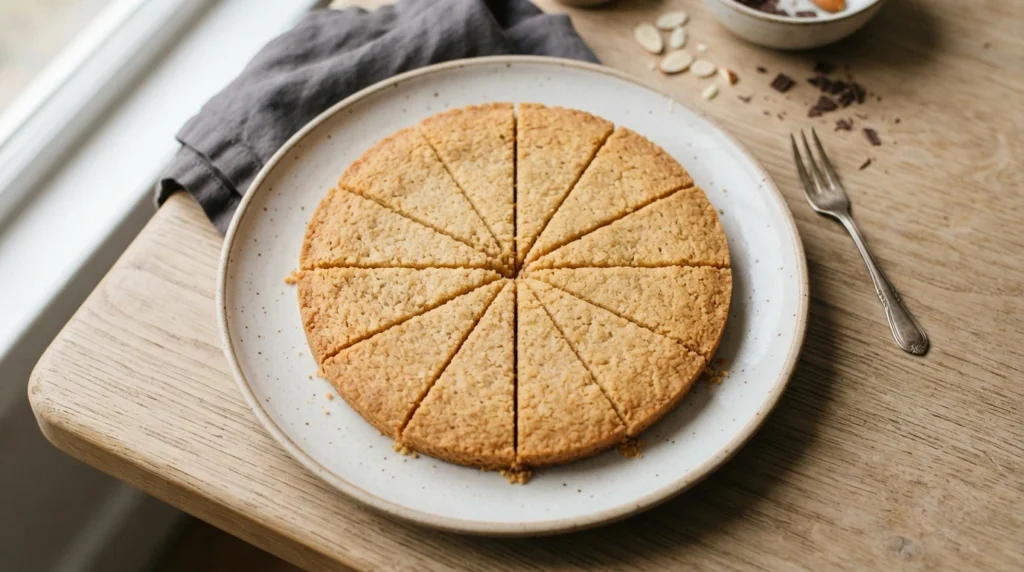

Shortbread is famous for being crumbly, but a version made with coconut flour and egg whites can be surprisingly firm and sliceable. This keto shortbread uses no butter or cream cheese, relying instead on the natural binding properties of eggs and the absorbency of coconut flour to create a texture that holds together when cut.
Why Coconut Flour Changes the Texture
Traditional shortbread depends on fat for structure. When you swap in coconut flour, which is highly absorbent and lacks gluten, the recipe needs different binders. The egg whites provide the necessary protein network to hold the crumbs together without the need for heavy fats or dairy.
The Result
When baked correctly, this shortbread should feel dense rather than crumbly. It will slice cleanly when warm but soften slightly as it cools. The goal is a cookie that stays intact on a plate without falling apart.
Recipe: Keto Coconut Flour Shortbread
Yield: About 10–12 servings (roughly 30 pieces)
Prep time: 10 minutes
Cook time: 15 minutes
Total time: 25 minutes
Ingredients
All ingredients should be at room temperature unless otherwise noted.
- Large egg whites: 6 (approx. 180g total), separated from yolks
- Coconut flour: 35g (unsweetened, fine grind)
- Pure maple syrup or liquid agave: 25g
- Baking powder: 1/4 teaspoon (approx. 1g)
- Salt: a pinch (approx. 0.5g)
- Vanilla extract: 1 teaspoon (optional, for flavor only)
Method
-
Preheat your oven to 325°F (160°C). Line an 8-inch or 9-inch round cake tin with parchment paper. Ensure the parchment extends slightly up the sides.
-
In a medium bowl, whisk together the egg whites until frothy but not fully whipped. The texture should be like stiff marshmallow fluff.
-
Add the maple syrup (or agave) and vanilla extract to the egg whites. Whisk gently to combine without deflating the mixture too much.
-
In a separate small bowl, sift together the coconut flour, baking powder, and salt.
-
Slowly add the dry ingredients to the wet ingredients while whisking continuously. Add them in two additions if needed, as coconut flour can clump quickly.
-
Scrape down the sides of the bowl and mix until a smooth, uniform dough forms. The batter should be thick enough to hold its shape when lifted with a spoon.
-
Spoon the mixture into the prepared tin. Press it gently with the back of a spoon or your fingers to create an even layer about 1/2 inch thick. Do not overpress, or the shortbread may crack during baking.
-
Bake for 15 minutes. The edges should turn a very light golden color while the center remains slightly soft.
-
Remove from the oven and let the shortbread cool in the tin on a wire rack for at least 30 minutes before removing it. This step is crucial for setting the structure.
Troubleshooting Common Issues
If your shortbread crumbles excessively, check these factors:
- Too much coconut flour: Coconut flour absorbs a lot of liquid. If you used more than 35g, the mixture may be too dry.
- Overbaking: Baking for longer than 15 minutes can cause excessive drying and cracking. Remove it when the edges are just golden.
- Insufficient cooling: Moving the shortbread from the tin before it has set will cause it to break apart.
Storage and Reheating
Store leftover shortbread in an airtight container at room temperature for up to 3 days. It can also be frozen for up to 2 months. To reheat, place individual pieces in the oven at 300°F (150°C) for 5 minutes to restore crispness.
Substitution Notes
This recipe is designed specifically for coconut flour due to its unique absorption rate. Swapping it for almond flour will change the texture significantly, resulting in a cakier, softer product rather than a firm shortbread. Do not substitute one-for-one without adjusting other ratios.