
Creating perfect keto mini cheesecakes often hinges on one major hurdle: preventing the filling from cracking or curdling while ensuring the crust holds its shape. For home cooks seeking satisfying, lower-carbohydrate desserts that avoid the complexity of a traditional water bath, baking directly in muffin cups offers a reliable solution.
Why Muffin Cups Work for Mini Cheesecakes
Using standard 12-cup or 24-cup muffin tins allows you to bake individual portions quickly. The small volume of the filling means it sets faster than a full-sized cake, reducing the risk of overcooking the delicate cheese texture. Furthermore, because the sides of the cup are close to the heat source, the crust forms evenly without needing extra flour or breadcrumbs.
Key Technique: Avoiding the Water Bath
Traditional cheesecakes often require a water bath (bain-marie) to maintain gentle, indirect heat. This can be fiddly and prone to leaking if not done perfectly. By baking in muffin cups at a moderate temperature, you achieve similar results—gentle even cooking—without the setup hassle. The key is to keep the oven temperature around 325°F (160°C) to ensure the protein structure coagulates slowly without tightening too quickly.
Simple Keto Mini Cheesecake Recipe
This recipe uses high-quality ingredients that mimic the richness of dairy-based cheesecakes while adhering to ketogenic macronutrient profiles. All ingredients are measured in grams for precision, ensuring consistent texture across batches.
Yield: 12 mini cheesecakes (approx. 4 oz each)
Total Time: 50 minutes
Prep Time: 15 minutes
Cooking Time: 35 minutes
Resting Time: 2 hours (chilling required)
Ingredients
- Graham Cracker or Almond Flour Crust:
- 100g almond flour (unsweetened, finely ground)
- 40g erythritol or allulose (pure sweetener, no bulk powder)
- 2 tsp vanilla extract
- 30g melted unsalted butter (cooled to room temp)
- Cheese Filling:
- 350g full-fat cream cheese (softened to room temperature)
- 150g sour cream (full fat, cold)
- 4 large eggs (room temperature)
- 60g erythritol or monk fruit blend
- 2 tsp vanilla extract
Method
- Preheat the Oven: Set your oven to 325°F (160°C). Ensure it is fully preheated before placing the cups inside.
- Prepare the Crust: In a medium bowl, whisk together the almond flour and sweetener. Add the melted butter and vanilla extract until the mixture resembles wet sand. Press this firmly into the bottom of 12 muffin cups using the back of a spoon or your fingers.
- Make the Filling: In a separate large bowl, beat the cream cheese on medium speed until completely smooth and creamy, about 2 minutes. Add the sour cream and continue beating until combined. Add eggs one at a time, mixing on low speed just until incorporated after each addition to avoid over-beating.
- Combine: Fold in the vanilla extract gently. The filling should be thick but pourable. It is normal for it to look slightly runny before baking; this will set as it cools.
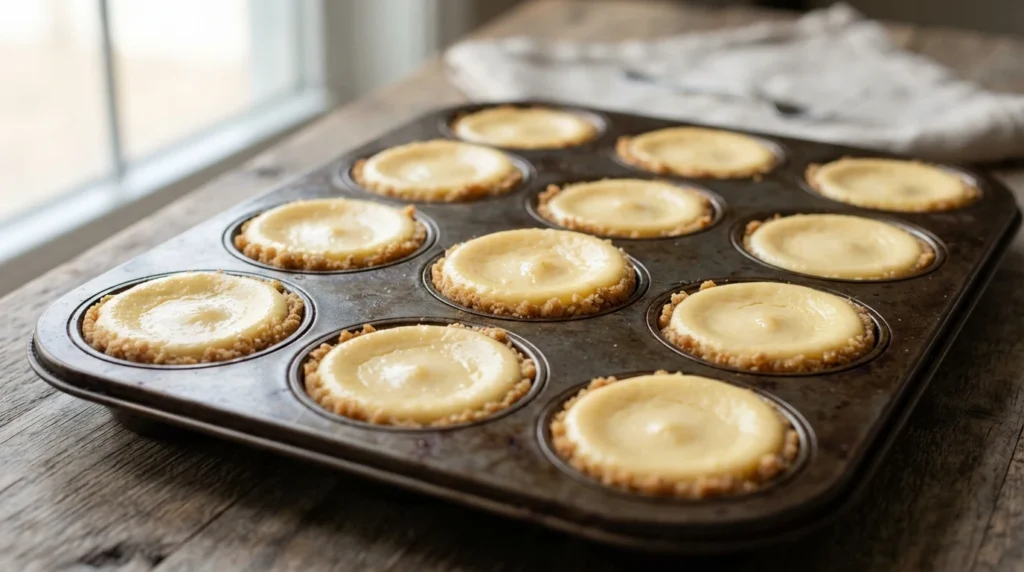
- Fill and Bake: Spoon the filling into the crust-lined cups, filling them about three-quarters full. Place the muffin tin on a baking sheet (this helps catch any potential drips). Bake for 30 to 35 minutes.
- Cheek Test: The cheesecakes are done when the edges are set and the center has a slight, soft jiggle when gently shaken. Do not overbake, or the texture will become rubbery.
- Cool and Chill: Remove from the oven and let cool at room temperature for 15 minutes. Then, cover loosely and refrigerate for at least 2 hours before serving to allow proper setting.
Troubleshooting Common Issues
Even with a simple recipe, texture issues can arise. Here is how to identify and fix the most common problems.
- Crackled Top: This usually happens if the oven temperature is too high or the filling is beaten too much before baking. The rapid heat causes the surface proteins to tighten, pulling away from the center. To prevent this, ensure your eggs and cream cheese are at room temperature so they blend smoothly without air pockets.
- Runny Center: If the center remains liquid after the suggested time, it likely needs more time in the oven. However, if you overbake it, the texture becomes dry. Check for doneness by rotating the tin; the edges should be firm while the center wobbles like Jell-O.
- Soggy Crust: If the bottom of the crust is wet, your almond flour may not have been ground finely enough, or there was excess moisture in the butter. Ensure the flour is a fine powder and that the butter is completely cooled before mixing.
Genuine Substitutions
While the recipe above uses standard keto staples, here are supported alternatives for specific dietary needs:
- Cream Cheese Swap: You can use full-fat Greek yogurt instead of sour cream for a tangier flavor, but reduce the sweetener by 10g as yogurt is slightly less sweet.
- Egg Substitute: Flax eggs (2 tbsp ground flaxseed mixed with 6 tbsp water) can replace one egg, though they may result in a slightly denser texture. They work best if you are making a larger batch rather than individual mini cups.
- Sweetener Choice: Allulose mimics sugar more closely than erythritol, providing better browning and a softer mouthfeel. If using erythritol, add an extra 5g to prevent crystallization.
Storage and Reheating
Keto mini cheesecakes are best served chilled. They can be stored in an airtight container in the refrigerator for up to 4 days. Freezing is possible: wrap individual cups tightly in plastic film, then place them in a freezer bag. Thaw overnight in the fridge before serving.
To reheat, warm them briefly in a microwave on low power (10-15 seconds) or in an oven at 300°F (150°C) for 5 minutes. Avoid high heat, as this will cause the filling to separate and lose its creamy texture.
Final Thoughts
Baking keto mini cheesecakes in muffin cups is a practical way to enjoy rich, low-carb desserts without the stress of large-scale baking. By focusing on gentle heat and proper ingredient temperature, you can achieve a silky texture that rivals traditional recipes. Remember that patience during the cooling phase is essential for the best result.