


5.8 C
New York
Thursday, March 5, 2026

Buy now

spot_img
Home Blog Page 20

Spotify Meets ChatGPT: AI Just Became My Personal DJ!”

ChatGPT’s new suite of apps has me hooked, but none more than the Spotify integration. With just a mention, ChatGPT offers to link my Spotify account, and I’m in. Here’s what happened when I let AI take control of my music:

Unveiling My Musical Past
I connected my Spotify account, and ChatGPT dove into my musical history. Turns out, my taste is a “chaotic blend of punk, jazz, and classic rock, with a lot of showtunes and children’s music lately.” Spot on! ChatGPT even broke down my daily listening habits – hype up tunes in the morning, Sesame Street and Beatles in the afternoon.

Discovering New Tunes
I asked ChatGPT to suggest new music based on my history. It delivered! I found myself grooving to under-the-radar punk bands, recent Broadway revival tracks, and Ella Fitzgerald B-sides. Even the obscure Sesame Street tune I was hunting down, “Put Down the Duckie,” was found in a flash.

Playlist Magic
ChatGPT’s other main trick? Making playlists from prompts. I asked for a nostalgic punk playlist for highway driving, and “Highway Punk” was born, complete with Green Day, Blink-182, and Jimmy Eat World. For my toddler, “Jazz Hands & Juice Boxes” blended Louis Armstrong with Bluey and Elmo, keeping both of us happy.

AI DJ: Hit or Miss?
I’ve always been a musical scatterbrain, but with ChatGPT’s help, I might become more informed. It’s no substitute for chatting with a musically savvy friend, but for finding forgotten tunes or creating playlists, AI’s got my back. So, who’s ready to let ChatGPT take control of their Spotify?


Windows 10’s End of Life: Over 40% of Global Endpoints Still at Risk!”

🚨 Attention, tech world! Windows 10 has officially reached its end-of-life status, and that means no more security updates, improvements, or upgrades. But here’s the kicker: over 40% of global endpoints are still running this now-unsupported OS, leaving them vulnerable to a host of threats!

The Ticking Time Bomb

Windows 10, once the darling of the PC world, has been quietly ticking away, waiting for this very day. With no more support from Microsoft, it’s only a matter of time before security holes are exploited, putting your data and devices at risk.

The Numbers Don’t Lie

Two major tech companies have crunched the numbers, and the results are eye-opening:

– Cloudhouse surveyed 135 finance IT leaders and found that a whopping 60% are still running “a large number” of servers and desktops with unsupported Windows versions.
– TeamViewer analyzed 250 million connections and found that more than 40% of global endpoints still run Windows 10.

The Struggle is Real

So, why the delay in migration? It turns out that many IT teams are drowning in legacy infrastructure, with 90% of organizations carrying Windows technical debt. And it’s not just about time – it’s about money too. Almost 95% of respondents wish they could spend more on strategic projects, but they’re stuck maintaining old systems.

The Race Against Time

Mat Clothier, CEO at Cloudhouse, warns, “Financial services firms shoulder acute operational risk from legacy Windows estates. This is a business-critical risk that drains budgets and prevents security and digital transformation work. With major Microsoft support milestones approaching in 2025, firms need actionable, low-risk migration pathways now.”

So, are you ready for the Windows 10 deadline?

Don’t miss our guide on how to prepare, and check out the best authenticator apps and password managers to boost your security while you’re at it! Stay safe out there! 🛡️💻

Unveiled: DRBench – The New Gold Standard for Enterprise AI Research Agents!”

🚀 Big News! ServiceNow Research has just dropped DRBench, a game-changer in the world of AI research agents. This isn’t your average benchmark; it’s a realistic, runnable environment designed to put “deep research” agents through their paces on complex, open-ended enterprise tasks. 🏢🔍

So, what’s DRBench all about?

DRBench is here to evaluate AI agents on tasks that matter to businesses. It’s about synthesizing facts from both the public web and private organizational data into well-cited reports. But here’s the twist: agents have to navigate through a maze of enterprise-style workflows, dealing with files, emails, chat logs, and cloud storage. No more easy web-only tests! 🌐📄

What’s inside DRBench?

The initial release comes packed with:
– 15 deep research tasks across 10 enterprise domains (from Sales to Cybersecurity).
– Each task has a deep research question, a task context (company and persona), and groundtruth insights hidden within realistic enterprise files and apps.
– A total of 114 groundtruth insights across tasks, verified by humans.

The Enterprise Environment

DRBench comes with a containerized enterprise environment that integrates commonly used services behind authentication and app-specific APIs. It’s like giving your AI agent a realistic workplace to operate in! 💼🔑

What gets scored?

DRBench evaluates AI agents on four key axes:
1. Insight Recall: How well the agent finds and reports the relevant insights.
2. Distractor Avoidance: How well the agent ignores irrelevant or distracting information.
3. Factuality: How accurate the final report is.
4. Report Quality: How well-structured and clear the final report is.

Meet DRBench Agent (DRBA)

The research team has introduced a task-oriented baseline agent, DRBA, designed to operate natively inside the DRBench environment. DRBA is organized into four components: research planning, action planning, a research loop with Adaptive Action Planning (AAP), and report writing. It’s like having a colleague to compare your AI agent’s performance with! 🤝💻

Why DRBench is a Game-Changer

Most “deep research” agents shine on public-web question sets, but production usage requires finding the right internal needles, ignoring distractors, and citing both public and private sources under enterprise constraints. DRBench directly targets this gap, making it a practical benchmark for system builders who need end-to-end evaluation. 🌟

Key Takeaways

– DRBench evaluates deep research agents on complex, open-ended enterprise tasks that require combining public web and private company data.
– The initial release covers 15 tasks across 10 domains, each grounded in realistic user personas and organizational context.
– Tasks span heterogeneous enterprise artifacts and the open web, going beyond web-only setups.
– Reports are scored for insight recall, factual accuracy, and coherent, well-structured reporting using rubric-based evaluation.
– Code and benchmark assets are open-sourced on GitHub for reproducible evaluation and extension.

Wanna know more?

Check out the [Paper](https://arxiv.org/abs/2510.00172) and [GitHub page](https://github.com/ServiceNow/drb) for more details. And while you’re at it, feel free to follow us on [Twitter](https://twitter.com/ServiceNow) and join our [100k+ ML SubReddit](https://www.reddit.com/r/MachineLearning/) and [subscribe to our Newsletter](https://www.servicenow.com/subscribe.html). Oh, and we’re on [Telegram](https://t.me/ServiceNowAI) now too! 📢📣

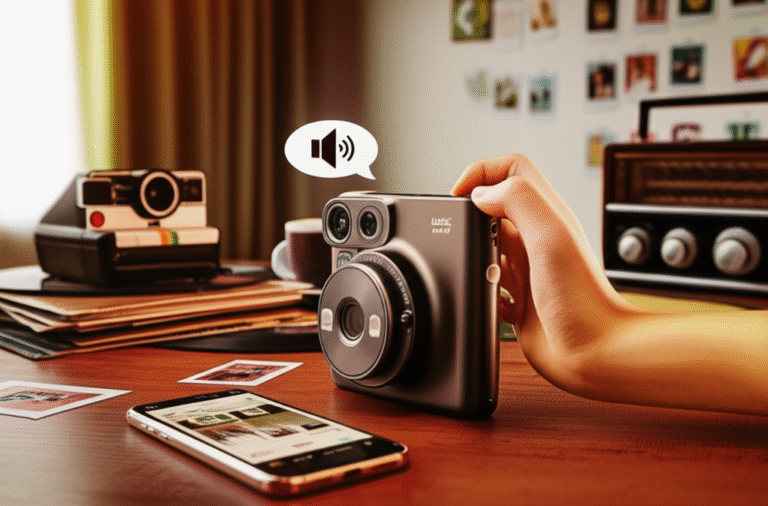
Snap & Sound: Fujifilm’s New Instax mini LiPlay+ Lets You Add Audio to Instant Photos & Rocks Twin Cameras! 🎶📸”

Fujifilm’s back with a bang, introducing the Instax mini LiPlay+ – a souped-up version of their 2016 hybrid instant camera! Six years in the making, this new model is here to make your photo game even more fun and interactive.

The Big Upgrade: Twin Cameras & Audio Clips!

The mini LiPlay+ retains its sleek design and rear LCD, but it’s now packing twin cameras! That’s right, folks – say goodbye to awkward selfies and hello to effortless snap-happy moments! Plus, with the new layered photo mode, you can combine front and rear camera images with two Instax color profiles to choose from.

But wait, there’s more! Fujifilm’s gone and added an audio feature that’ll make your photo albums truly multi-sensory. With the Instax mini LiPlay+ app, you can record short audio clips to be added to your images – talk about a blast from the past!

Colors & Pricing: Midnight Blue, Sand Beige, & More!

The mini LiPlay+ comes in two stunning colors – Midnight Blue and Sand Beige – and will be available from October 30. Priced at £189.99 (around $250 / AU$390), it’s a steal for all the fun it brings. And if you want to keep your camera safe in style, matching cases are available for an extra £29.99.

New Film Alert!

Fujifilm’s also debuting a new ‘Soft Glitter’ Instax Mini film on the same day, costing £8.99 for a pack of 10. Stay tuned for US and Australia pricing!

Hybrid Instant Cameras: Not for Analog Purists, But a Blast for the Smartphone Generation!

The mini LiPlay+ is perfect for those who love the ease and control of smartphones but crave the instant gratification of physical prints. While it might not be for analog purists, it’s a fantastic option for the rest of us who want to have fun with our photography without breaking the bank.

I’ve got my hands on one right now, so keep an eye out for my review! In the meantime, let me know your thoughts in the comments below – are you excited about this hybrid instant camera, or do you prefer the old-school Instax cameras?

Say Goodbye to Sticky Fingers: Kobo’s New Remote Page Turner is Here!”

Ever found yourself in a cozy reading nook, buried under blankets, only to be interrupted by the need to stretch out and press that pesky page-turn button? Kobo, our beloved ereader brand, has heard our cries for help! They’ve just announced a game-changer: a remote page turner designed to keep your hands free and your reading experience uninterrupted.

Mark your calendars, folks! This nifty gadget will be available worldwide from November 4, in both black and white variants. While we were secretly hoping for a new ereader (Kobo’s been quiet on that front in 2025), this remote is a fantastic consolation prize.

Now, remote page turners aren’t exactly new, but most of the cheap ones you find online are hit or miss, especially with brands other than Kindle. Kobo’s new remote, however, is Bluetooth-enabled and designed to work seamlessly with their own ereaders. No more glitchy page turns or compatibility issues!

If you’re already a proud owner of a Bluetooth-enabled Kobo ereader, get ready for minimal movement and maximum reading comfort. I, for one, can’t wait to get my hands on this (well, not literally, since it’s hands-free!).

The Kobo Remote will set you back $29.99 in the US and AU$44.95 in Australia. UK pricing is yet to be confirmed. Happy hands-free reading, everyone!

You might also like…
– “The Best Ereaders to Buy – All Tried and Tested”
– “Kindle vs Kobo: Which Ereader Brand is Better?”
– “Read My In-Depth Kobo Libra Colour Review – It’s My Fave Ereader”
– Or check out my reviews of the Kobo Clara Colour or Kobo Clara BW for more affordable options.

🎧 Alert! These Hidden Gem Headphones Just Got 36% Cheaper, and They’re Packed with Surprises!

When you’re on the hunt for new headphones, you probably look at the big names like Bose, Sony, or Apple. But hold up! Let us introduce you to the AKG N9 Hybrid over-ears, the underdog that’s giving the heavyweights a run for their money. These babies tick all the boxes you’d expect, plus they’ve got a secret weapon that boosts your device’s audio quality to high-res levels. And the cherry on top? They’re now 36% off at Amazon!

Our AKG N9 Hybrid review was blown away by these headphones. They’re comfortable, sound fantastic, and have a USB-C dongle that’s hidden in the left ear cup. Plug it into your compatible device, and it’ll upgrade your audio to high-res, plus give you a more stable and instant connection than Bluetooth. It’s like magic!

But the party tricks don’t stop there. These headphones have a whopping 100-hour battery life with ANC off, and up to 45 hours with it on. That’s more than what you’d get from the big brands. The noise cancellation is impressive, and you can tweak settings like EQ and spatial audio with a smartphone app.

Sound quality is stunning, with a beautifully balanced profile that makes them perfect for music, movies, and gaming. One pair for all purposes? Yes, please!

Even at their original price of AU$499.95, the AKG N9 Hybrid was a steal. But now, with a 36% discount on the white colorway, they’re an absolute bargain. The black pair also gets a discount, but it’s only 19%. Don’t miss out!

Not convinced? Check out more of the best headphones our experts recommend. Or if you prefer in-ear headphones, take a look at the best wireless earbuds. And if you’re a Sennheiser fan, you might want to check out the HDB 630, which also has a USB-C dongle, but it’s double the price of the AKGs. Happy listening!

Unleash Your ML Code: Write Once, Run Everywhere with Ivy!”

🚀 Ever dreamt of writing machine learning code that just works across NumPy, PyTorch, TensorFlow, and JAX? Ivy, the revolutionary library, makes this dream a reality! Dive into our engaging tutorial and witness the power of framework-agnostic ML development.

🌟 What’s in store for you?

1. Framework-Agnostic Neural Network: We kickstart our journey by crafting a simple neural network purely in Ivy. Watch it run seamlessly on four major backends, proving Ivy’s ability to abstract away framework differences while maintaining efficiency and accuracy.

2. Smooth Transpilation & Interoperability: Next, we explore Ivy’s prowess in enabling smooth transpilation and interoperability between frameworks. We take a simple PyTorch computation and reproduce it identically in TensorFlow, NumPy, and JAX using Ivy’s unified API.

3. Unified API Across Frameworks: In this section, we test Ivy’s unified API by performing various mathematical, neural, and statistical operations across multiple backends. Seamless execution and consistent results confirm Ivy’s coherent interface that works everywhere.

4. Advanced Ivy Features: We delve into Ivy’s power features beyond the basics. We organize parameters with `ivy.Container`, validate Array API-style ops across backends, and chain complex steps to see graph-like execution flow.

5. Performance Benchmarking: Finally, we benchmark the same complex operation across NumPy, PyTorch, TensorFlow, and JAX to compare real-world throughput. This helps us choose the fastest stack for our workload.

🎯 Key Takeaways:
– Write ML code once and run it on any framework with Ivy.
– Operations work identically across NumPy, PyTorch, TF, and JAX.
– Unified API provides consistent operations across backends.
– Switch backends dynamically for optimal performance.
– Containers help manage complex nested model structures.

🌐 Next Steps:
– Build your own framework-agnostic models.
– Use `ivy.Container` for managing model parameters.
– Explore `ivy.trace_graph()` for computation graph optimization.
– Try different backends to find optimal performance.
– Check docs at: [https://docs.ivy.dev/](https://docs.ivy.dev/)

Join us on this exciting journey to unlock the full potential of your machine learning code with Ivy! 🚀💻🧠

Check out the [FULL CODES here](link-to-codes).

Follow us on [Twitter](link-to-twitter), join our [100k+ ML SubReddit](link-to-reddit), and subscribe to our [Newsletter](link-to-newsletter).

Now you can also join us on [Telegram](link-to-telegram)!

Happy coding! 💻🎉

Get Ready for Lightning-Fast Phones: UFS 5.0 Promises Speeds Blasting Past Laptops, Thanks to AI!”

🚀 Brace yourselves, tech enthusiasts! The next generation of smartphone storage is about to blow your mind. The JEDEC Solid State Technology Association has just revealed that UFS 5.0 is on its way, and it’s bringing speeds that’ll make your current phone feel like a snail!

💥 Mark your calendars for 11GB/s! The new standard promises sequential read and write speeds of up to 10.8GB/s, nearly doubling what UFS 4.1 can do. That’s right, your future phone could be faster than many mid-range laptops today!

🧠 AI is the game-changer here. As mobile processors rely more on AI for tasks like real-time translation and voice recognition, storage systems need to keep up. UFS 5.0 is designed to be “flash optimized for AI, mobile, and edge devices,” so expect smoother performance when you’re using those nifty AI features.

🤔 But will you notice the difference? While these speeds sound amazing, there are still questions about real-world benefits. Will apps launch faster? Will file transfers be lightning-quick? Or will this mainly help behind-the-scenes AI tasks? Only time will tell.

🛠️ More than just speed. UFS 5.0 isn’t just about breaking records; it’s also about making your phone more secure and power-efficient. It comes with integrated link equalization for signal reliability, a distinct power supply rail to reduce interference, and inline hashing for better data integrity.

💰 The catch? Cost and battery life. The challenge now is to make all these improvements without hiking up manufacturing costs or draining your battery faster. Let’s hope phone manufacturers can strike the right balance!

📣 Stay tuned for more updates! We’ll keep you posted on when UFS 5.0 starts rolling out, and what it means for your daily phone use. Until then, enjoy the anticipation of lightning-fast smartphones! 💨📱

Meta’s ARE & Gaia2: Revolutionizing AI Agent Testing in Real-World Scenarios!”

🚀 Meta AI has just upped the game with Agents Research Environments (ARE) and Gaia2! Let’s dive into what these game-changers are and why they matter.

What’s ARE & Gaia2 all about?

– Agents Research Environments (ARE) is a modular simulation stack that helps create and run agent tasks. It’s like a giant LEGO set for AI agents!
– Gaia2 is the sequel to GAIA, a benchmark that evaluates AI agents in dynamic, write-enabled settings. It runs on top of ARE and focuses on skills beyond just search-and-execute.

Why the shift from sequential to asynchronous interaction?

Most AI agent tests pause the world while the model ‘thinks’. ARE changes the game by decoupling agent and environment time. The environment keeps evolving while the agent reasons, throwing in scheduled or random events (like messages, reminders, updates). This forces agents to be proactive, handle interruptions, and be deadline-aware – skills often overlooked in synchronous settings.

How’s the ARE platform structured?

ARE is time-driven and treats ‘everything as an event’. Here’s how it’s organized:

1. Apps: Stateful tool interfaces (like email, messaging, calendar).
2. Environments: Collections of apps, rules, and data.
3. Events: Logged happenings.
4. Notifications: Configurable observability for the agent.
5. Scenarios: Initial state + scheduled events + verifier.

Tools are typed as read or write, making it easy to verify actions that change state. The initial environment, Mobile, mimics a smartphone.

What does Gaia2 actually measure?

Gaia2 tests general agent capabilities under real-world pressure:

– Adaptability to environment responses
– Handling ambiguity and noise
– Time constraints (actions within tolerances)
– Agent-to-Agent collaboration

How big is the benchmark?

The public dataset card specifies 800 scenarios across 10 universes. The paper’s experimental section references 1,120 verifiable, annotated scenarios in the Mobile environment.

How are agents scored in a changing world?

Gaia2 evaluates sequences of write actions against oracle actions with argument-level checks. This ensures that agents are judged on their entire journey, not just the end state.

Why should you care?

ARE + Gaia2 shift the target from static correctness to correctness-under-change. If your AI agent claims to be production-ready, it should handle asynchrony, ambiguity, noise, timing, and multi-agent coordination – and do so with verifiable write-action traces.

Wanna know more?

Check out the [Paper](https://ai.meta.com/research/publications/are-scaling-up-agent-environments-and-evaluations/), [GitHub Codes](https://github.com/facebookresearch/are), and [Technical Details](https://ai.meta.com/research/publications/are-scaling-up-agent-environments-and-evaluations/). Also, feel free to follow Meta AI on [Twitter](https://twitter.com/meta) and join their [100k+ ML SubReddit](https://www.reddit.com/r/MachineLearning/) and [Newsletter](https://www.facebook.com/meta/learn-more/newsletter/). And if you’re on [Telegram](https://t.me/meta), you can join them there too!

Microsoft’s MAI-Image-1: A New Kid on the Block, Already in LMArena’s Top 10!”

Microsoft AI has just unveiled its first-ever in-house text-to-image model, MAI-Image-1, and it’s making waves! As of October 13, 2025, this newcomer has stormed into the Top-10 of the LMArena text-to-image leaderboard. But that’s not all – Microsoft is currently seeking public feedback by testing MAI-Image-1 in the arena, and they promise it’s coming “very soon” to Copilot and Bing Image Creator.

Microsoft’s MAI-Image-1 is all about creativity. It’s been designed with a focus on unique, non-repetitive outputs, avoiding generic styles. The model excels in generating photorealistic images, with stunning lighting effects and landscapes. But speed is another key feature – Microsoft boasts that MAI-Image-1 is faster than many larger systems, making it perfect for quick iterations and seamless handoffs to downstream creative tools.

This isn’t Microsoft AI’s first foray into in-house models. They’ve previously rolled out MAI-Voice-1 and MAI-1-preview. Now, they’re expanding into generative media with MAI-Image-1, which is set to integrate with consumer-facing products like Copilot and Bing Image Creator.

While Microsoft hasn’t yet shared the nitty-gritty details like architecture and parameter count, the model’s focus on consumer-grade interactive throughput suggests it’s been tuned for real-time use, rather than offline batch rendering. This aligns with its intended delivery into Copilot endpoints.

The image-generation market is crowded, but Microsoft seems ready to compete on image quality and latency under its own brand. If MAI-Image-1 maintains its LMArena standing and integrates into Copilot and Bing Image Creator with the promised speed, it could become the go-to option for Windows and Microsoft 365 users needing fast, photorealistic image synthesis.

So, keep your eyes peeled for MAI-Image-1’s sustained rank on LMArena, measurable throughput in production, and any technical disclosures that shed light on how this model achieves its impressive speed-quality balance. The future of image generation just got a whole lot more exciting!

Follow by Email
YouTube
WhatsApp