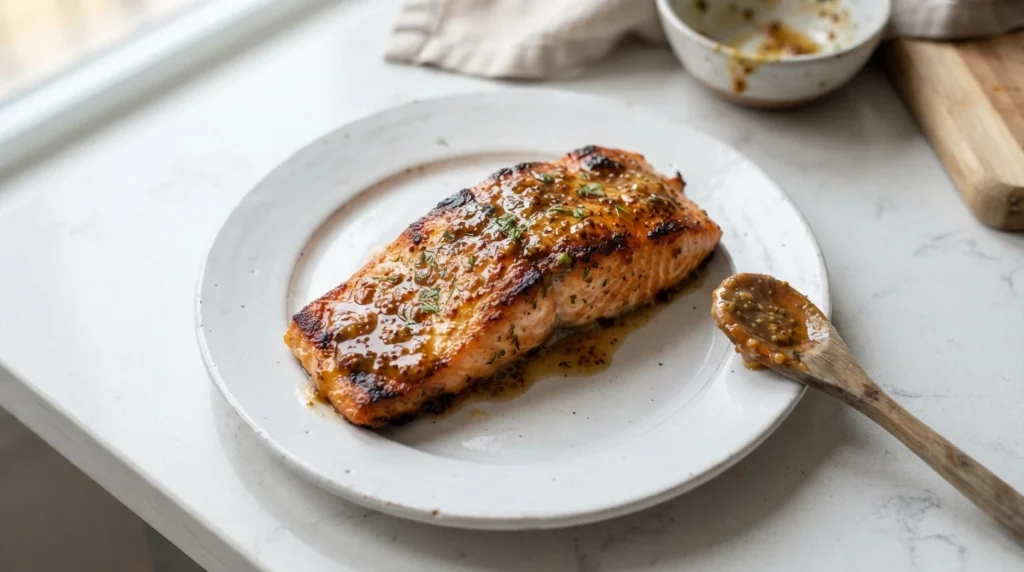

Air Fryer Honey Mustard Salmon: A Simple Finish
Salmon cooked in an air fryer is prized for its ability to cook quickly without drying out, but it requires careful timing to balance a flaky interior with a caramelized exterior. The key challenge here is the sauce: honey mustard begins to burn before the salmon reaches its safe internal temperature. To solve this, we prepare the fish dry and apply the glaze only in the final minutes of cooking.
Recipe Overview
- Servings: 2
- Total Time: Approx. 18 minutes (including prep)
- Prep Time: 5 minutes
- Cooking Time: 13 minutes
Equipment Needed
A standard air fryer basket capable of holding two salmon fillets side-by-side without crowding. Do not use a baking dish unless it is specifically designed for air frying, as liquids can drip and steam the food rather than crisp it.
Ingredients
- Salmon fillets: 2 pieces (approx. 150g each), skin-on if desired, cut to fit the basket width
- Olive oil: 10g (for brushing fish)
- Honey: 20g (for glaze)
- Dijon mustard: 15g (for glaze)
- Salt and black pepper: to taste
Instructions
Step 1: Preparation
Pat the salmon fillets completely dry with paper towels. Moisture on the skin prevents crispness. Brush the tops of the fillets lightly with the olive oil (10g). Season generously with salt and black pepper.
Step 2: Preheat and Load
Preheat your air fryer to 375°F (190°C) for about 3 minutes. Place the salmon fillets in the basket, skin-side down if possible, ensuring they are not touching. Overcrowding traps steam and results in soggy fish.
Step 3: Initial Cook
Cook for 8 to 10 minutes at 375°F (190°C). Do not add the glaze yet. The goal is to cook the fish through without burning the sugars in the honey.
Step 4: Check Doneness
At the 8-minute mark, insert a food thermometer into the thickest part of the fillet (avoiding the bone if present). The salmon is ready when it reaches an internal temperature of 125°F to 130°F (52°C to 54°C) for medium-rare or 135°F to 140°F (57°C to 60°C) for well-done. It should still look slightly translucent in the center if you prefer it rare, but ensure it reaches at least 125°F.
Step 5: The Glaze Finish
In a small bowl, whisk together the honey (20g) and Dijon mustard (15g). Remove the basket from the air fryer. Brush half of the glaze mixture over the top of each fillet. Return the basket to the air fryer.
Step 6: Final Cook
Cook for an additional 2 to 3 minutes at 375°F (190°C). Watch closely; the honey will bubble and darken slightly. The salmon is done when it reaches your preferred internal temperature, which will likely be between 140°F and 145°F (60°C to 63°C) after this step.
Troubleshooting
- Salmon is dry: Likely caused by overcrowding the basket or cooking at too high a temperature. Ensure fillets are spaced apart and reduce heat to 350°F (175°C) for larger pieces.
- Glaze burns: Honey caramelizes quickly. If bubbles form rapidly, remove the basket immediately. You can also dilute the glaze with a teaspoon of water or lemon juice if it seems too thick.
- Fish is undercooked: Air fryers vary in heating power. Always rely on a food thermometer rather than time alone. If you are unsure, add 1-2 minutes but check frequently.
Serving and Storage
Serve immediately while warm. The glaze thickens upon contact with the hot fish, creating a sticky sauce ideal for dipping or spooning over rice or roasted vegetables. Leftovers can be stored in an airtight container in the refrigerator for up to 2 days. Reheat gently in the air fryer at 325°F (160°C) for 3-4 minutes to refresh the texture.
Frequently Asked Questions
Can I use boneless salmon?
Yes, boneless fillets cook slightly faster. Adjust the cooking time by 1-2 minutes if using smaller, thinner cuts, but always verify with a thermometer.
Is it safe to eat rare salmon in an air fryer?
Yes, provided the internal temperature reaches at least 125°F (52°C). The USDA recommends 145°F (63°C) for safety, but many consumers prefer a slightly softer texture as long as the fish is cooked through to the center.
Can I add vegetables?
You can add broccoli florets or bell peppers in the first cooking phase. However, do not add them in the last 3 minutes unless they are pre-cooked, as they will steam rather than roast if placed too late.