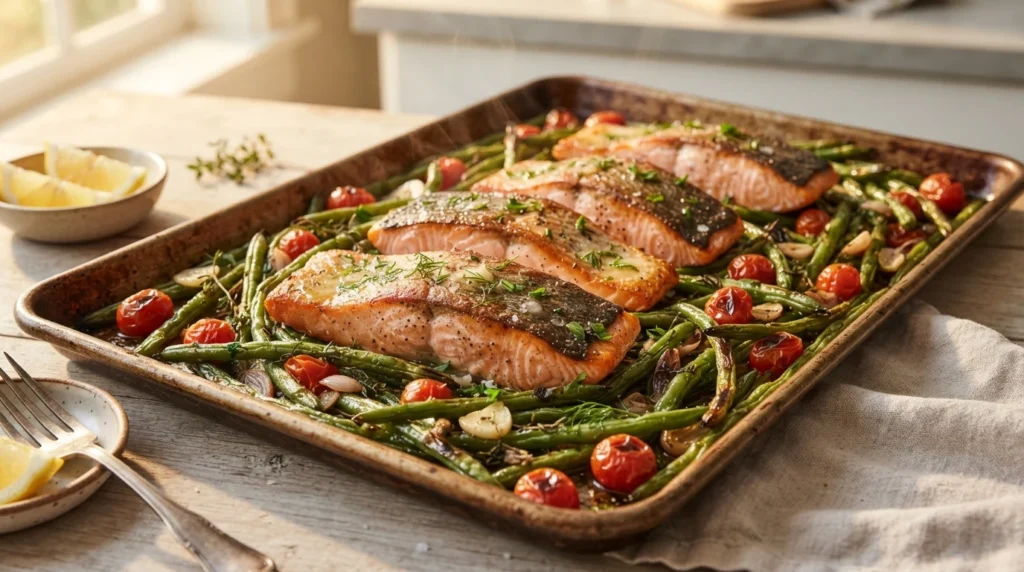

Looking for a quick, low-carb dinner that cooks itself? This sheet-pan salmon with green beans recipe delivers crispy skin, tender fish, and charred vegetables all in under 30 minutes. The method relies on proper pan temperature to ensure the salmon cooks through without drying out while the beans develop caramelized edges.
Recipe Overview
This dish provides a balanced meal with approximately 4 servings per pan. It requires about 15 minutes of prep time and 20–25 minutes of cooking time, depending on your oven’s temperature and the thickness of your fillets.
Yield and Timing
- Servings: 4
- Total Time: 35 minutes (including prep)
- Cooking Method: Roasting on a baking sheet
Ingredients
All measurements are in grams unless otherwise noted. The recipe uses standard US and metric equivalents for clarity.
- Salmon fillets: 600g (approx. 4 pieces, skin-on), raw
- Green beans: 350g (trimmed), raw
- Olive oil: 2 tablespoons (approx. 28g)
- Lemon juice: 1 tablespoon (approx. 15ml, fresh squeezed)
- Dijon mustard: 1 teaspoon (approx. 5g)
- Salt and black pepper: To taste
- Paprika: 1 teaspoon (optional, for color)
Method
- Preheat the oven: Set your oven to 200°C (400°F) and place a rack in the center position. This ensures even heat circulation around both the fish and vegetables.
- Prepare the pan: Line a large baking sheet with parchment paper or foil for easy cleanup. Lightly grease the surface with a small amount of olive oil to prevent sticking.
- Cut the vegetables: Wash the green beans thoroughly and trim the ends. Cut them into 3–4cm lengths, ensuring they are roughly uniform in size so they cook evenly.
- Season the salmon: Pat the salmon fillets dry with paper towels to remove excess moisture. This step is critical for achieving crispy skin. Season both sides generously with salt and pepper. If desired, sprinkle a pinch of paprika on top for visual appeal.
- Cook the vegetables: Spread the green beans in a single layer on the baking sheet, leaving space between them. Drizzle lightly with olive oil and season with salt and pepper. Avoid overcrowding the pan, as this traps steam and prevents browning.
- Add the fish: Place the salmon fillets skin-side down on one half of the baking sheet, next to the vegetables. Ensure they do not overlap or touch the beans directly if you prefer distinct textures.
- Roast: Bake for 15–20 minutes. The salmon is done when it flakes easily with a fork and the internal temperature reaches 63°C (145°F). Check early if your fillets are thin, as they may take less time.
- Finish with acid: Remove the pan from the oven. Drizzle the lemon juice over the salmon just before serving to brighten the flavor without cooking it further.
Troubleshooting Common Issues
Here are practical solutions for common problems encountered when roasting fish and vegetables together:
- Soggy skin or rubbery texture: This usually results from steaming instead of drying. Ensure the salmon is completely dry before cooking, and place it skin-side down first so the oil seeps into the flesh.
- Dry fish: Overcooking is the most common cause. Use a meat thermometer to check internal temperature rather than relying on color alone. Remove the pan while there is still 2–3 minutes of rest time remaining for carryover cooking.
- Burnt vegetables: If the beans are browning before the fish is cooked, move the salmon to a separate plate and return the sheet pan to the oven. This prevents uneven cooking.
Suggested Substitutions
If you need to adapt this recipe for dietary preferences or availability:
- Fish substitute: Cod or halibut fillets can replace salmon, but they are leaner and require slightly lower heat (175°C/350°F) to prevent drying.
- Vegetable swap: Asparagus or broccoli florets work well in place of green beans. Adjust cooking time by 2–4 minutes, as these vegetables often cook faster.
- Flavor variation: Swap Dijon mustard for soy sauce (check sodium content) for an Asian-inspired profile, but note that soy contains carbohydrates if consumed in large quantities.
Storage and Reheating
To store leftovers, cool the dish completely within two hours of cooking. Refrigerate in an airtight container for up to 3 days. For best quality, freeze individual portions for up to 2 months.
When reheating, use an air fryer at 180°C (350°F) for 4–6 minutes or microwave on high for 1–2 minutes. Avoid microwaving the salmon directly, as it tends to become rubbery; adding a splash of water and covering with a damp paper towel can help retain moisture.
Frequently Asked Questions
Can I cook this without an oven?
Yes, you can use a stovetop skillet. Place the salmon skin-side down in a cold pan, then add oil and heat gently over medium-low for 4–5 minutes until crisp. Add beans later to prevent burning.
Is this keto-friendly?
Yes, this dish is naturally low-carb with approximately 2–3 grams of net carbs per serving, depending on the specific variety of green beans used.