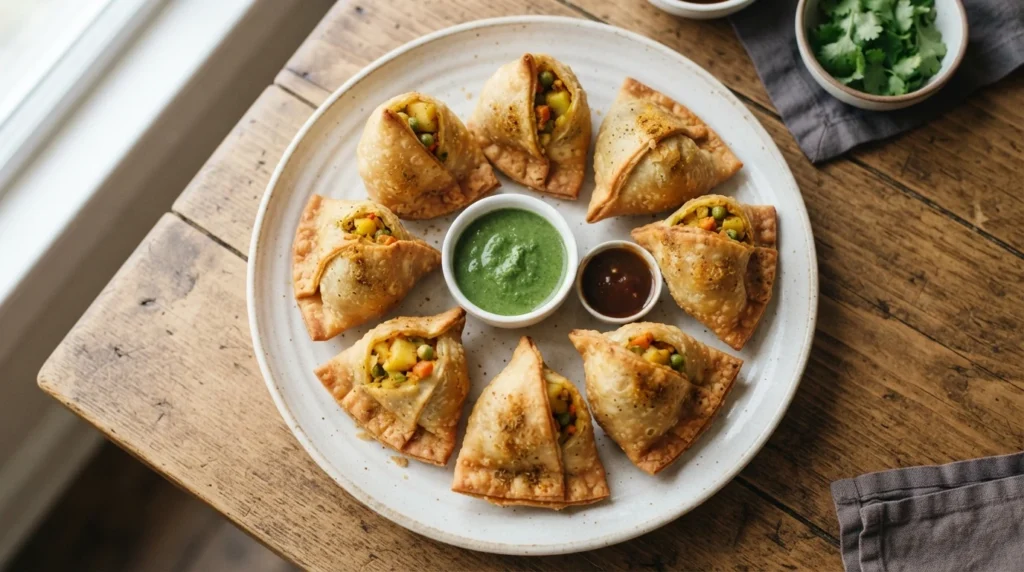

Creating homemade samosas in an air fryer is a practical solution for achieving the signature flaky, crisp texture of Indian street food without deep-frying. This method solves the common problem of soggy fillings and uneven browning by controlling moisture at each stage: using a fully cooked potato-pea base, sealing edges tightly, and arranging pieces with space for airflow.
Why Air Frying Works for Samosas
Traditional samosas are deep-fried, which requires significant oil and careful monitoring to prevent burning the outside before the inside is hot. The air fryer circulates hot air rapidly, cooking the filling evenly while crisping the pastry shell through convection heat. To ensure success, the filling must be cooked separately before assembly; raw potatoes take too long to cook through the dough wrapper in the air fryer, and peas become mushy if overcooked during frying.
Overview
- Yield: 8 samosas
- Preparation time: 25 minutes (includes filling and assembly)
- Air frying time: 12–15 minutes per batch
- Total elapsed time: Approximately 35–40 minutes
The recipe assumes you have access to a standard air fryer basket with a capacity of roughly 6–8 pieces. If your appliance is smaller, cook in two batches of four. Ensure the pastry sheets are thawed if frozen and pliable enough to seal without cracking.
Equipment Needed
Air fryer with a non-stick basket or perforated tray. A large mixing bowl for the filling. A rolling pin (optional, if using store-bought square dough). Parchment paper or silicone baking mats (cut to fit the basket and placed on the bottom only).
Ingredients
For the Potato Pea Filling:
- Large red potatoes: 400 grams, peeled and diced into 1 cm cubes
- Frozen green peas: 150 grams, thawed and drained
- Onion: 1 medium large (approx. 120 grams), finely chopped
- Garam masala: 2 teaspoons
- Cumin seeds: 1 teaspoon
- Chili powder: ½ teaspoon
- Salt: 1 teaspoon
- Oil (vegetable or canola): 2 tablespoons, for sautéing
For the Pastry and Assembly:
- Samosa dough sheets: 8 pieces (approx. 100 grams total), thawed if frozen
- Oil for brushing: 2 tablespoons
- Water or milk: 2 tablespoons, for sealing edges
Method
Step 1: Prepare the Filling
In a large skillet over medium heat, add the oil. Add the diced potatoes and cook uncovered for 8–10 minutes, stirring occasionally, until they are tender but not mushy. You want them to hold their shape when mixed with peas. Add the chopped onion and cook for another 3 minutes until softened. Stir in the thawed peas, garam masala, cumin seeds, chili powder, and salt. Cook for 2 more minutes to toast the spices slightly. Remove from heat and let cool completely before assembling. The filling must be at room temperature; hot filling will melt the pastry edges.
Step 2: Assemble the Samosas
Lay one samosa sheet flat on a clean work surface. Place a scoop (approx. 40–50 grams) of the cooled potato-pea mixture in the center, forming a rough oval shape. Fold the bottom corner up over the filling, then fold the top corner down to create a cone shape. Bring the two side corners together and pinch firmly to seal completely. The seam should be tight; use a little water or milk on the edges if necessary to help the dough adhere. Brush the top edge of each samosa with oil to promote browning.
Step 3: Air Fry
Place parchment paper in the bottom of the air fryer basket. Arrange the samosas in a single layer, ensuring they do not overlap or touch. If your basket is crowded, cook in two batches. Set the air fryer to 200°F (95°C). Cook for 12 minutes, then open the basket and carefully turn each samosa over using tongs. Continue cooking for another 3–5 minutes, or until the pastry is golden brown and crisp.
Step 4: Check Doneness
Cut one samosa in half to check the filling. It should be piping hot throughout. The potatoes must be fully soft, not crunchy or undercooked. If the pastry looks pale after 12 minutes, increase the temperature slightly to 205°F (96°C) and cook for another 2 minutes, checking frequently to avoid burning.
Step 5: Serving
Serve immediately while hot. These pair well with a cooling chutney or raita. Allow them to rest on a wire rack after frying to prevent steam from softening the bottom crust.
Troubleshooting
- Pale pastry: The air fryer temperature may be lower than expected, or the pieces were overcrowded. Try increasing heat slightly and ensuring a single layer.
- Soggy filling: The potatoes were not cooked long enough in the skillet before assembly. Ensure they are very tender when mixed with peas.
- Leaking filling: The edges were not pinched tightly enough or the dough was too thin. Re-seal the seams firmly.
- Burnt exterior: Cooking time exceeded the limit significantly, possibly due to a larger batch size. Monitor closely once you reach the 10-minute mark.
Substitutions
If you cannot find samosa dough, use thin crepe sheets or phyllo dough, though they may require more oil for sealing. For the filling, you can substitute half of the potatoes with butternut squash, diced similarly. Do not substitute raw potatoes for cooked ones in the air fryer; the cooking time would be excessive and the texture undesirable.
Storage and Reheating
Store leftovers in an airtight container in the refrigerator for up to 3 days. Reheat directly in the air fryer at 180°F (85°C) for 4–6 minutes until hot. Do not leave perishable food out at room temperature; refrigerate promptly after serving.
Frequently Asked Questions
Can I cook the samosas in a regular oven?
Yes, bake on a baking sheet at 400°F (200°C) for 15–20 minutes, flipping halfway through. The air fryer generally yields a crispier exterior.
Is it safe to eat a samosa if the potato filling looks slightly firm?
Ensure the internal temperature of the filling reaches at least 165°F (74°C) using a food thermometer inserted into the center. Visual cues alone are not reliable for safety.
How do I store the pastry sheets beforehand?
Keep thawed samosa dough in the refrigerator or freezer. If frozen, allow it to sit at room temperature for 10–15 minutes before rolling to prevent cracking from cold dough.